On 9 January 2026, Kenya switched on the Kenya Education Management Information System (KEMIS), the platform meant to replace the ageing National Education Management Information System (NEMIS) and, in the words of Ministry of Education officials, give the country a single-click view of any learner’s journey from nursery to university. By June, the rollout had teeth: schools that weren’t captured in KEMIS risked losing third-term capitation altogether, public and private institutions alike. Read article here
Five months after KEMIS went live, and in the same month that schools were told to register or lose funding, a room full of edtech founders, educators and program managers sat down at iHUB to ask a more uncomfortable question: does Kenya actually know how to *use* the data it is now so aggressively collecting? The session, “The Architecture of Insight,” wasn’t designed as a commentary on KEMIS specifically. Even though the session wasn’t convened to discuss KEMIS and didn’t set out to comment on it, what participants said maps closely onto the problems KEMIS is now running into in practice: schools are expected to comply with the new system before anyone has built the capacity to actually use what it collects; a centralized national platform doesn’t automatically reflect what’s happening in an individual classroom; and the people generating the data (i.e. schools, teachers, learners) aren’t necessarily the ones who benefit from it being collected.


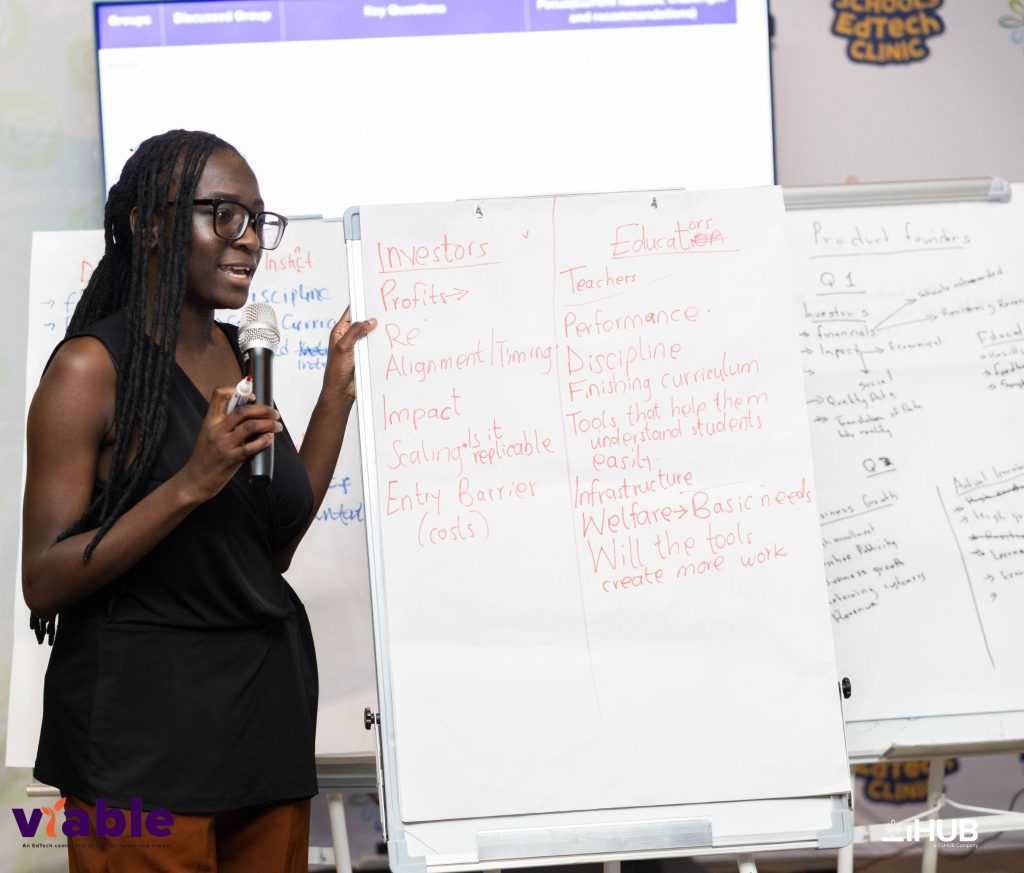
The session’s clearest finding was also its most structural: investors and educators are not measuring the same thing, even when they’re looking at the same dashboard. Investors consider whether a model can sustain itself and grow: recurring revenue, user acquisition, scalability, and replicability within an investment horizon. Educators consider whether a tool actually improves teaching: student performance, curriculum completion, reduced administrative load, and better feedback loops. Infrastructure and teacher welfare get acknowledged but treated as enablers, not the measure of success itself.
This isn’t a new tension in edtech, but it has a particular bite in Kenya right now. KEMIS is, functionally, an investor-grade metric machine for government: it produces exactly the kind of clean, verifiable, fundable numbers enrolment counts, transition rates, capitation eligibility that satisfy funders and donors. What it isn’t yet built to surface is whether a learner is actually learning better as a result. The session’s participants would recognise this gap immediately: it’s the same one they described between edtech platforms that can prove “high usage” while struggling to prove improved comprehension or retention. A system can be impeccably good at the metrics that unlock money while saying almost nothing about the metrics that matter inside a classroom.“Whenever we onboard schools, they look at how simple it is… a kid who has never interacted with tech can maneuver within minutes.”
The session’s recommendation: a shared framework that values business performance and educational effectiveness together, rather than as competing priorities.
Growth-stage edtech and the capitation deadline are the same story
Participants were candid that early-stage edtech ventures default to growth metrics because growth is what keeps them alive and that the discipline of also tracking real learning outcomes (portfolios, internship readiness, demonstrable skill progression) tends to arrive later unless it’s a deliberate choice is made to build it in from the start rather than treat it as a luxury for later.
Schools facing the KEMIS capitation deadline are living a public-sector version of the same pressure. The incentive in front of them right now is registration and compliance to get every learner captured correctly or lose funding, not pedagogical insight. That is a rational response to the incentive structure, exactly as it was rational for the edtech founders in the session to chase user growth first. But the session’s own case study material flags what happens next if that’s where it stops: data climbs up to government and funder reports requirements, and rarely climbs back down in a form that helps a teacher or a head teacher make a better decision tomorrow morning. NEMIS was criticised for exactly this, reliable enough for funding allocation, far less useful as a tool school leaders actually reached for to manage their own institutions.
If KEMIS is going to break that pattern rather than repeat it at greater scale, the session’s insight is the one to hold onto: the balance between “data that proves viability” and “data that improves learning” doesn’t happen automatically. It has to be designed in.
Ownership is the question underneath the technical question
The session’s discussion on data ethics drew a distinction that is about to matter a great deal more in Kenya: the difference between identity data and performance or behavioural data. Participants were unambiguous that personally identifiable information belongs to the learner and needs strong consent protections, while aggregated, anonymised performance data can legitimately be used to improve products and inform policy provided that separation is real and enforced, not just stated.
KEMIS raises the stakes on this distinction considerably. The system is being built around a Unique Personal Identifier issued at birth under the broader “Maisha” digital identity ecosystem, designed to track a learner and eventually a person across their entire educational and civic life, with the same identifier potentially carrying through to death registration. That is a long way from an anonymised engagement dashboard. It is precisely the kind of centralised, persistent, cross-linked identity record the session’s participants were instinctively wary of, even as they recognised the genuine planning value that comes from being able to follow a learner’s transitions and target interventions accurately.
The session’s proposed answer: data portability modelled on credit transfer between universities, learner control over identity records, aggregation as the default mode for anything used beyond direct learner support is a reasonable starting framework. But it was developed before KEMIS went live and became mandatory for school funding. The ethical groundwork the session called for arguably needed to exist before January 2026, not as a retrofit now.
The deeper diagnosis: infrastructure is outrunning culture
The session’s most pointed “hot take” challenged a line from Kenya’s Deputy President at the 2026 Global Data Festival that data systems are core development infrastructure determining how well every other investment is planned. Participants didn’t reject the principle. They rejected the implied sequencing. Their argument, in essence: Kenya keeps building the pipes faster than it builds the people who can read what flows through them.
The evidence for this from the session itself is concrete: teachers and school leaders largely absent from the design of the data policies that govern their own classrooms; discipline and intervention decisions still running on instinct because no consistent tracking exists for them; data collection experienced as an administrative burden rather than as a tool that gives anything back. The concept note’s own background section names the same four structural gaps independently: fragmented systems operating in silos, limited data literacy among the people expected to act on insights, equity blind spots in how data is used to target underserved learners, and rich edtech data that never reaches policy tables.
KEMIS is, on paper, an attempt to solve exactly the first of those four fragmentations by unifying NEMIS, TVET records, university data and agency systems like KNEC and TSC into one platform. That is real progress on the infrastructure side of the ledger. But infrastructure consolidation does not automatically produce data literacy, trust or a culture where a class teacher feels ownership over the numbers being collected about her classroom. The session’s central warning that a country cannot be considered data-driven simply because it has data, only if that data demonstrably changes decisions applies with full force to a freshly unified national system as much as it does to a fragmented one. A bigger, cleaner pipe still empties into the same gap if nobody downstream has been equipped to use what comes out of it.
What the comparison with Finland actually offers
The concept note’s reference to Finland is useful precisely because it resists the instinct to treat Finland as a system to copy rather than a logic to learn from. Finland’s education data culture isn’t built on more surveillance or higher reporting frequency, it’s built on institutional trust, teacher autonomy and a default assumption that data exists to support learning, not to police it. Kenya’s environment is structurally different: weaker connectivity in many counties, less decentralised authority at the school level, and as the session’s participants candidly noted, a historical memory in which data collection has often meant monitoring or control rather than support. Importing Finland’s dashboards without importing the trust that makes those dashboards usable would simply produce another well-built system nobody believes in.
Where this leaves Kenya’s education-data ecosystem, right now
Put the session’s findings next to the live state of the ecosystem and a fairly specific set of priorities falls out, sharper than a generic “invest in data literacy” recommendation:
- Build the feedback loop KEMIS doesn’t yet have: Compliance and capitation data flowing upward needs a deliberate, designed pathway flowing back down to school leaders and teachers in a form they can act on, not just a system that confirms who is registered.
- Separate identity infrastructure from performance infrastructure in practice, not just in policy language: With a lifelong Unique Personal Identifier now central to the national system, the session’s call for learner-controlled identity data and aggregated-only performance sharing needs concrete technical and legal teeth, not goodwill.
- Put educators inside the design room before the next system, not after: Every stakeholder group in both documents converges on this: systems built without teacher input get low adoption regardless of how technically sound they are.
- Treat edtech’s learner data as an underused public asset, ethically handled: Founders are sitting on engagement and outcome signals that could meaningfully sharpen public planning currently isolated in private dashboards, not because of malice but because no shared, trusted pathway exists to bring it into the policy conversation.
- Measure the thing the session kept circling back to: whether a decision actually changed: Not whether a dashboard exists, not whether a school is registered, but whether a teacher, a founder or a policymaker made a different, better choice because of the data in front of them.
Final quote from the session was a challenge to policymakers and founders alike:
“There is no one standard way. You don’t write everything, but it’s the same thing over and over again. Let us focus on the children, so that results.”
The session’s own framing captures it best: the primary challenge facing Kenya’s education ecosystem is no longer the collection of data. KEMIS has, in a few short months, made that collection both comprehensive and mandatory. The harder, slower work the one the session was actually convened to talk about is building a culture where all of that data is trusted enough, understood enough and connected enough to decisions that it stops being a repository and starts being, as the session’s title promised, an architecture of insight.
Authors: Auralia Mboya and Lilian Kibagendi.