About Cohort 4
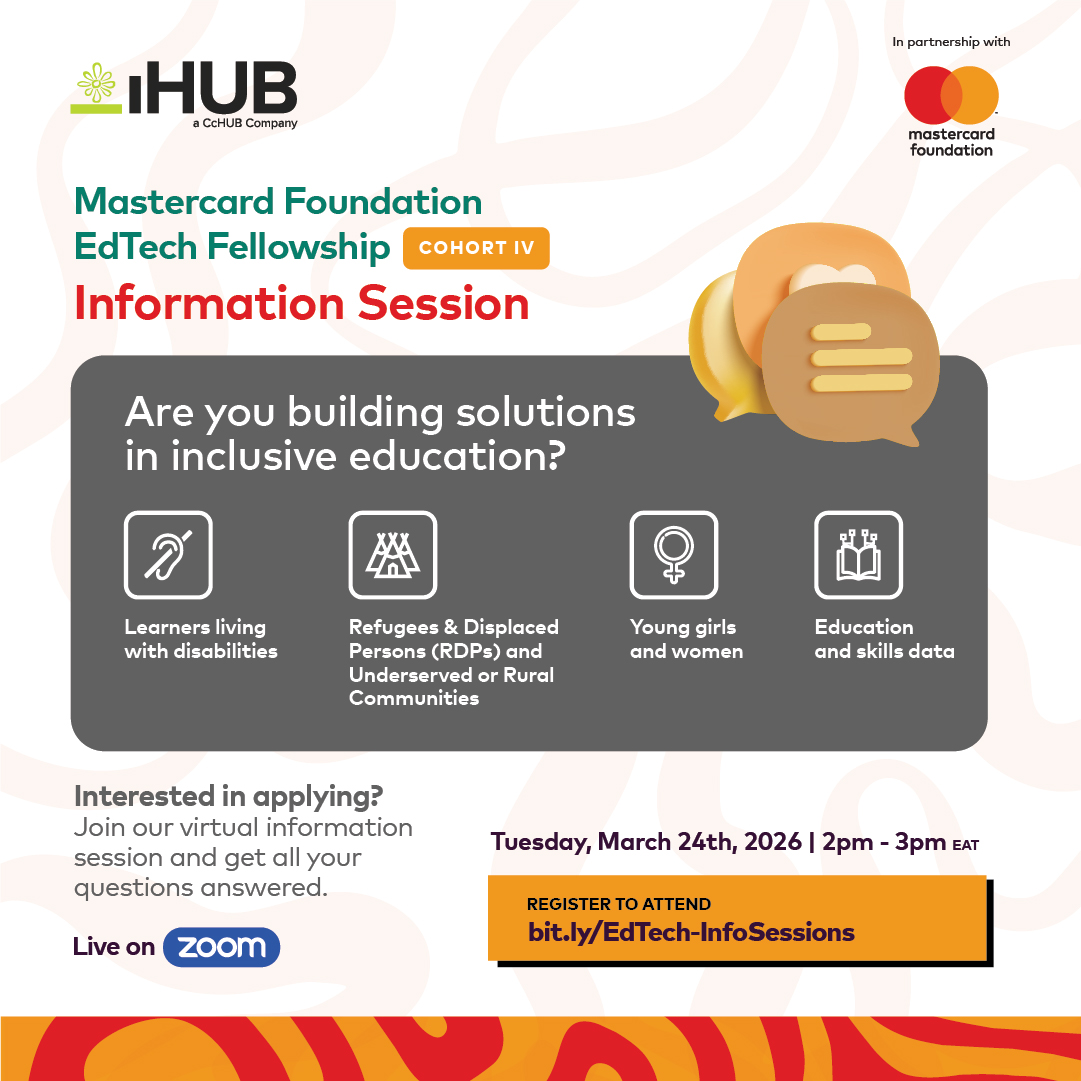
iHUB, in partnership with The Mastercard Foundation, is calling for applications for the 4th cohort of the EdTech Fellowship focused on supporting early-stage innovators developing inclusive, context-relevant solutions that improve learning outcomes and expand access to education for underserved learners. Selected innovators will receive structured support to strengthen their solutions, improve implementation readiness and expand their reach.
Problem Statement
Kenya’s EdTech systemically excludes learners living with disabilities, refugees, displaced persons (RDPs)and underserved or rural communities, and young girls and women. This is worsened by poor accessibility, weak infrastructure, gender barriers and inadequate decision-making data. Bridging these gaps demands inclusive, low-tech, flexible, and data-driven solutions for learning, earning and data integration for educational planning.
Solutions for Learners Living with Disabilities
The Problem
Existing EdTech solutions generally lack features that address the diverse range of disabilities within target populations. Stakeholders emphasized that "disability inclusion appears to be treated as an afterthought rather than a core design priority, with organizations acknowledging its importance but lacking the expertise, resources, and strategic focus to deliver truly inclusive solutions." This results in systematic exclusion of some of the most vulnerable learners from technology-enabled educational opportunities.
Content design limitations exclude learners by failing to provide alternative formats such as audio descriptions, captions, and sign language interpretation. Technology and interface barriers—including navigation systems requiring precise touchscreen interactions, small text and buttons, and poor compatibility with assistive technologies, disadvantage learners with motor, visual, and sensory impairments. Research shows that only 15% of Kenyan EdTech platforms include basic accessibility features.
The Opportunity
Solutions are needed that help learners with varying cognitive, hearing, and visual disabilities gain knowledge and build skills. This requires universal design principles including multi-sensory content delivery (text, audio, visual, tactile elements); customizable user interfaces allowing adjustments to font size, color, contrast, and pacing; flexible navigation options (keyboard, voice, switch access); and full compatibility with assistive technologies. Kenya's assistive technology market is estimated at KSh 2.3 billion annually, representing significant opportunity for inclusive EdTech solutions.
Teacher Training and Support
The Problem
Teacher capacity constraints present a systemic barrier. Stakeholders reported that "many teachers lack foundational digital skills, alongside limited training in inclusive pedagogy, assistive technology, and differentiated instruction." Without intensive and targeted professional development, educators are ill-equipped to support learners living with disabilities, even when accessible tools are available. Only 8% of Kenyan teachers have received training in special needs education, and fewer than 5% are comfortable using assistive technologies. In refugee settings, this challenge intensifies.
Teachers are often drawn from displaced populations with limited formal training and minimal exposure to technology. High teacher attrition—as teachers exit due to resettlement, return to home countries, or pursuit of better opportunities—results in continuous loss of institutional knowledge. Stakeholders noted that "each departure necessitates retraining of replacement staff, making one-off capacity-building interventions insufficient."
The Opportunity
Solutions are needed that train and support teachers managing classrooms with children of multiple abilities, and provide assistance tools for teachers with disabilities. Training should cover assistive technology fundamentals, inclusive pedagogical approaches, and practical guidance on integrating Individual Education Plans into digital platforms. Given high teacher turnover, models should prioritize clear documentation, peer-to-peer mentoring, and intuitive platform design minimizing the learning curve for new teachers.
Assistive Tool Maintenance and Support
The Problem
Even when assistive devices are provided, lack of maintenance and repair services limits their lifespan and impact. Harsh environmental conditions in refugee camps and ASAL regions, dust, heat, humidity, accelerate hardware degradation. Stakeholders emphasized that "high temperatures significantly reduce battery life and device longevity, particularly in camp settings," and that "rapid technological obsolescence makes large-scale device provision unsustainable."
Without local repair capacity, broken devices accumulate. Organizations described "the device graveyard phenomenon where broken hardware sits unused due to lack of repair capacity." Current models rely heavily on donor subsidies, creating significant risk when funding cycles end. Approximately 40% of educational devices in Kenyan refugee camps are non-functional at any given time.
The Opportunity
Technology-enabled or hybrid solutions are needed that provide ongoing support and maintenance for assistive tools in special needs schools. These should establish sustainable, locally-driven maintenance ecosystems enabling NGOs, government institutions, and communities to maintain functionality, rapidly troubleshoot issues, access spare parts, and train local technicians.
Continuity of Learning and Livelihoods
The Problem
Learners living with disabilities in Kenya face barriers across all learning contexts. In formal schools, teacher capacity gaps limit inclusive instruction. At home, parents and caregivers lack resources and training to sustain learning. Most critically, pathways from foundational education to vocational training and employment remain largely inaccessible. Persons with disabilities in Kenya face unemployment rates exceeding 80%, with minimal access to technical and vocational education. Kenya's National Special Needs Education Policy aims to ensure inclusive education,but implementation gaps persist. The technical and vocational education and training (TVET) sector remains largely inaccessible to persons living with disabilities, with fewer than 2% of TVET institutions offering disability-specific programs.This lack of continuity from school to skills to livelihoods perpetuates cycles of poverty and exclusion.
The Opportunity
Solutions are needed that can be used both in formal education institutions and by caregivers/parents at home to ensure continuity of learning. Additionally, solutions supporting the transition of learners living with disabilities into TVET institutions for technical skills and livelihoods are critical to enabling economic participation and breaking cycles of exclusion.
Low-Tech/Livelihood Solutions
The Problem
Young people in refugee camps and ASAL regions lack pathways from learning to livelihood. Refugee youth face 75% unemployment rates, while ASAL youth experience similarly high joblessness. Economic activity is predominantly informal, yet skills programs often design for formal employment that doesn't exist in these contexts. Learning disruptions occur more frequently and with greater severity due to climate shocks, security incidents, health emergencies, and displacement.
Stakeholders noted that during closures, organizations experiment with remote learning via SMS, WhatsApp, and radio. However, while digital devices can provide content access, they cannot replace the pedagogical role of teachers, and learning quality suffers significantly in the absence of instructional support. Without clear connections to income generation and entrepreneurship, learning remains disconnected from survival economics.
The Opportunity
Solutions are needed to help young people build livelihood and entrepreneurship skills using low-tech or tech-enabled approaches. These must link skills development directly to education to work transitions, including employability and entrepreneurship (income-generating opportunities within informal economic contexts) recognizing that 90% of economic activity in refugee camps is informal. The solutions should also include features for recognition and portability of learning in order to facilitate re-entry into national education and skills systems without loss of progress.
Affordable Access to Devices and Connectivity
The Problem
Infrastructure constraints are extreme and qualitatively distinct from typical rural schools. Power access varies widely: rural schools experience intermittent grid connectivity; ASAL regions are largely off-grid, relying on costly solar systems with high maintenance burdens; refugee camps operate entirely off-grid with solar infrastructure vulnerable to vandalism, theft, and environmental degradation.
Internet connectivity mirrors these extremes. Rural areas contend with weak mobile signals, ASAL regions face unreliable networks with prohibitively expensive data bundles, and refugee camps experience connectivity described as "minimal to non-existent, rendering online-dependent solutions largely unusable." Device availability is critically constrained: rural schools operate at 1:4-8 device-to-learner ratios, ASAL contexts rely heavily on shared devices, and refugee camps experience extreme scarcity. In one IRC-supported camp, "49 devices served approximately 1,200 learners"—a 1:24 ratio. Only 15% of households in Kenyan refugee camps have any digital device.
The Opportunity
Solutions are needed for affordable, structured, and consistent access to devices and connectivity as a service. This includes ruggedized devices designed for extreme environmental conditions (heat, dust, humidity), sustainable off-grid power solutions, low-bandwidth connectivity models, and shared device programs that maintain functionality despite infrastructure deficits. In addition, solutions may include systems that can ensure learners identification, learning analytics and progress tracking.
Support Services for Devices
The Problem
Device security is a pervasive concern, with severity increasing in fragile contexts. Stakeholders noted that refugee camps face acute risks of theft and break-ins, leading organizations like UNHCR to centralize devices in designated learning hubs, "prioritizing asset protection over learner access." Some schools allocate scarce resources to hire security personnel rather than invest in learning materials. Teacher digital literacy gaps compound these challenges. Stakeholders reported that "many teachers struggle with basic digital tasks, including email and password management," with low teacher morale and reluctance to adopt digital tools. Without foundational capacity building before advanced digital tools are introduced, devices remain underutilized even when functional. Among teachers in ASAL regions, only 23% report comfort with basic digital tools.
The Opportunity
Services are needed that provide maintenance and support for devices provided by external entities, including repair services and digital literacy training for teachers and facilitators. These should build foundational digital literacy and pedagogical technology integration capacity through training approaches that are practical, confidence-building, culturally appropriate, and sustainable despite teacher turnover. In addition, solutions may include systems that can ensure learners identification, learning analytics and progress tracking.
Offline Learning and Language Barriers
The Problem
Connectivity constraints make offline-first design essential but create challenges for data synchronization and instructional responsiveness. Stakeholders emphasized that while alignment with Kenya's national curriculum is critical for certification and learner mobility, "KICD-approved content is often not adapted for camp-specific realities," with lack of culturally relevant and localized content for refugee and pastoralist communities.
Language barriers significantly limit learning. Many refugee learners have limited proficiency in English, the primary medium of instruction. Kenya has over 60 languages, with significant linguistic diversity in ASAL regions and refugee camps. Stakeholders noted the need for "mother-tongue content, visual and audio-based learning, peer translation models, or multilingual interfaces that don't assume English or Kiswahili proficiency." Research shows that only 35% of refugee children in Kenya are proficient in the language of instruction.
The Opportunity
Low-tech/offline solutions are needed that facilitate continuous teaching and learning, enable skill building, and address language barriers for teachers and students in refugee camps and ASAL communities. These should leverage SMS, USSD, WhatsApp, radio, offline materials, and community learning models while providing multilingual content addressing linguistic diversity.The solutions should also include features for recognition and portability of learning in order to facilitate re-entry into national education and skills systems without loss of progress.
Transition from Learning to Earning
The Problem
Women and girls in refugee camps, ASAL regions, and remote communities face compounded barriers transitioning from learning to earning. These include limited formal education, caregiving responsibilities, mobility restrictions, cultural expectations around women's work, lack of startup capital, and limited access to markets and financial services. Female youth unemployment in Kenyan refugee settlements exceeds 85%, while women in ASAL counties earn 60% less than men on average.
Gendered household roles significantly affect participation. Stakeholders noted that "girls in pastoralist and refugee settings often shoulder disproportionate responsibilities for childcare, water collection, and domestic labor, leading to irregular attendance." Even when women acquire skills, they struggle to access credit—only 26% of women in rural Kenya have bank accounts compared to 44% of men.
The Opportunity
Solutions are needed that create integrated learning-to-earning pathways enabling women and girls to acquire marketable skills, access income-generating opportunities, build entrepreneurial capacity, and transition from educational programs into sustainable livelihoods despite structural barriers. This includes connecting skills training to market access, microfinance, and digital financial services.
Flexible Learning and Livelihoods
The Problem
Cultural and religious gatekeeping strongly influences what educational content is permitted, particularly in pastoralist and refugee communities. Stakeholders highlighted "resistance from community leaders toward digital content perceived as 'foreign,' with heightened opposition to sexual and reproductive health education. Psychosocial, life skills, and gender equality content often requires extensive contextualization to avoid rejection, as "content approval processes are typically controlled by male traditional and religious leaders." Time poverty compounds access barriers. Women in ASAL regions spend an average of 5.2 hours daily on unpaid care work compared to 1.8 hours for men. Stakeholders identified that "flexible, self-paced EdTech solutions that allow learners to catch up after absences were identified as particularly beneficial for sustaining girls' learning continuity."
The Opportunity
Solutions are needed that design flexible, culturally appropriate learning accommodating the unique socioeconomic contexts and life circumstances of women and girls. This includes self-paced, interruptible, home-based, or community-based learning opportunities that respect cultural norms while challenging barriers to educational access and economic empowerment, and that strengthen existing livelihoods through digital skills integration.
General Education and Policy
The Problem
Device access and safety concerns carry gendered implications. Stakeholders noted that "decisions to store devices exclusively in schools reflect security considerations but intersect with household power dynamics where girls frequently have less autonomy over technology use than boys."Online safety measures must account for risks disproportionately affecting girls, cyberbullying and sexual exploitation—without becoming restrictive controls that further limit access to information.
Only 18% of Kenyan women in rural areas report feeling confident using digital platforms, with lower rates in refugee and ASAL contexts. Topics central to girls' empowerment, menstrual health, prevention of early marriage and pregnancy, recognition of gender-based violence, and leadership development—face disproportionately higher barriers than gender-neutral academic content. Girls aged 15-19 in Kenya's ASAL counties have teen pregnancy rates exceeding 40%, yet comprehensive sexuality education remains heavily restricted.
The Opportunity
Solutions are needed offering general education interventions for empowerment (health, finances, legal rights, online safety) and platforms to share gender-responsive policies. These should build foundational digital literacy, confidence, and technological agency among women and girls through trauma-informed, culturally appropriate approaches that position women as technology creators rather than merely consumers, while ensuring safeguarding mechanisms protect without restricting autonomy.
Data Gathering and Use
The Problem: Severe Data Infrastructure Deficits
Education data systems are weak or nonexistent across refugee camps, pastoralist regions, and remote rural schools. Stakeholders reported that "device utilization in many supported schools has never been systematically assessed, leaving content engagement largely unmeasured. This lack of post-deployment visibility represents a systemic failure undermining evidence-based programming, individualized learner support, and accountability to funders and policymakers. Extreme device scarcity fundamentally compromises individual learner tracking. In refugee camps, IRC reported "approximately 49 devices serving over 1,200 learners a 1:24 ratio forcing multiple students to share devices and, in some cases, user accounts. This makes individual progress tracking functionally impossible, rendering learning analytics unreliable and negating the core value proposition of digital learning: personalization.
Extreme device scarcity fundamentally compromises individual learner tracking. In refugee camps, IRC reported "approximately 49 devices serving over 1,200 learners a 1:24 ratio forcing multiple students to share devices and, in some cases, user accounts." This makes individual progress tracking functionally impossible, rendering learning analytics unreliable and negating the core value proposition of digital learning: personalization.
The Problem: Limited Capacity and Connectivity
Offline-first design creates significant challenges for data synchronization. Learning data stored locally on devices cannot inform timely pedagogical decisions until connectivity allows synchronization—often infrequent or unreliable. Teacher capacity to interpret and act on data is limited. Stakeholders noted that "many teachers struggle with basic digital tasks, making sophisticated analytics tools impractical without foundational data literacy training. High teacher attrition further erodes capacity. Kenya's EMIS captures only 60% of schools nationally, with significant gaps in refugee settlements (estimated 20% coverage) and ASAL counties (estimated 35% coverage).[55] Gender-disaggregated data is often incomplete or unreliable, limiting ability to track equity outcomes.
The Opportunity
Solutions are needed that:
• Support government data gathering objectives: Create interoperable systems aligning with national and subnational government data agendas, integrate seamlessly with existing EMIS, support evidence-based policy making and resource allocation, track progress toward national education goals and SDGs, and function despite infrastructure constraints.
• Enable ease of analysis, visualization, and access: Build comprehensive data ecosystems connecting learner-level tracking (attendance, progress, assessment) with school-level management (resources, teacher deployment) and system-level planning (policy analysis, resource allocation, equity monitoring) across diverse contexts, from urban schools to off-grid refugee camps.
• Address technical and capacity challenges: Include offline-capable progress tracking with local data storage and delayed synchronization; individual learner identification across shared devices using simple IDs or QR codes; low-bandwidth, incremental data transmission; radically simple teacher-facing dashboards with visual cues and automated alerts; and gender-disaggregated data ensuring equity monitoring.
Who Should Apply?
The program will focus on four thematic areas, which are:
- Solutions for Learners Living with Disabilities.
- Solutions for Refugees & Displaced Persons (RDPs), and Underserved or Rural Communities
- Solutions focused on young girls and women.
- Solutions focused on education and skills data.
Program Benefits
- Expert advisory from experts across learning science, product development, talent management, distribution, investment and other key areas.
- Guidance from domain experts in inclusive design practices, special education, gender inclusion and education policy.
- Access to a community of practice to test products in real delivery settings, connecting startups to pilot partners and real users for feedback, learning and improved learning outcomes.
- Access to equity-free funding of $100,000.
- Networking with other founders building amazing solutions in EdTech.
- Exposure to a vibrant network of investors.
- Access to an exclusive perks and benefits repository.
Programme Structure
An 18-Month Comprehensive Journey designed to accelerate inclusive
EdTech startups across Kenya’s diverse educational landscape.
Phase 1: Incubation
Focused on foundational growth and product-market fit through a rigorous research-led methodology.

Learning Science & Product
Human-centered and inclusive design practices.

User Research
Testing and iteration with target demographics.

Guidance from Domain Experts
Special education, gender inclusion, education systems, and policy.

Pilot Implementation Support
Test solutions in real contexts and strengthen readiness for adoption.
Phase 2: Scaling
Scaling your impact and ensuring long-term financial and operational sustainability in the market.

Go-to-Market
Strategic entry into the broader Kenyan market.

Investor Readiness
Preparing for seed funding and impact investment.

Sustainability
Developing robust long-term business models.

Partnership Growth
Building networks with schools and NGOs.
Eligibility Criteria
Identify if your startup is the right fit for our inclusive education cohort in Kenya. We are looking for founders building the future of accessible learning.
Legal & Operational
Business Registration
Your startup must be legally incorporated in Kenya, with physical presence in Kenya.
Kenya Ownership
The company must be majority Kenyan-owned.
Product & Team
Minimum Viable Product (MVP)
A functional MVP that has been tested with at least a small group of users. Ideas on paper are not eligible for this cohort.
Inclusion Focus
The solution must directly address barriers in inclusive education, specifically targeting learners living with disabilities or marginalized groups.
Pilot & Partnership Commitment
An 18-Month Comprehensive Journey designed to accelerate inclusive
EdTech startups across Kenya’s diverse educational landscape.
Piloting is a core and non-negotiable component of Cohort 4. All applicants must submit a pilot plan outlining:
- Where and with whom the solution will be tested
- The intended learning and user outcomes
- The implementation approach
- High-level pilot budget and resource assumptions
- Why the pilot is feasible within the programme timeline
Selected startups will be expected to:
- Partner with a strategic organisation (e.g., schools, NGOs, community-based organisations, refugee-serving institutions, public agencies)
- Allocate a portion of the equity-free funding toward pilot implementation, based on the approved pilot plan
Why this fellowship matters.
The Inclusive EdTech Innovation Cohort is an 18-month structured support programme designed to help early-stage startups at the MVP or post-MVP stage with a small but verifiable user base that improve learning outcomes and expand access to quality education.
Selected startups will receive hands-on support to strengthen product design, apply learning science principles, and conduct structured pilots with real users. The goal is to ensure that solutions are not only innovative, but effective, inclusive, and contextually relevant.

Application Status
Open
Application Deadline
April 10th 2026, 11:59PM EAT
How to Apply
Step 1: Click the Apply Now button below to access the application form.
Step 2: Complete the Online Application. Fill in all required details about your startup, solution, and impact.
Step 3: Review your responses and confirm all information is accurate and complete before submitting.
Step 4: Submit your application on or before 10th April 2026, 11:59PM EAT
Applications will be reviewed in 3 stages
1. Assessment
Interested innovators are to apply using the provided application link. In this stage, the EdTech solutions will be assessed on the following criteria:
- Problem/Solution Fit
- Founder Potential
- Business Model Fit
- Traction
2. Evaluation
Selected EdTech solutions from the first stage will be assessed based on the following criteria:
- Scalability
- Long-term
- Plan/Vision
- Competitive Advantage
- Team Potential
3. Interviews
The final stage will be an interview with applicants who have successfully gone through the assessment stage. A final selection will then be made, subject to due diligence.